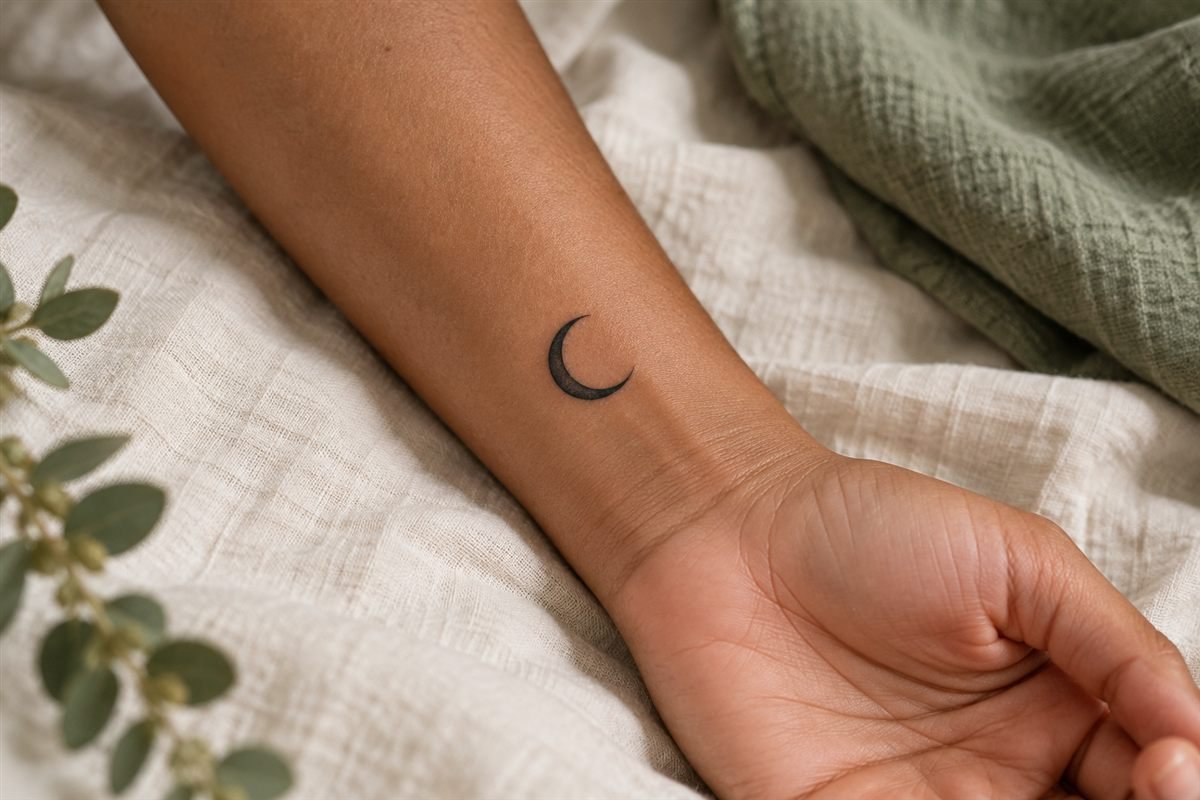
A wrist tattoo can face toward you when you raise your hand or face outward when your arm hangs down. Both choices can be intentional. The useful decision is which view you want to prioritize, especially when the design contains words or a clear top and bottom.
Identify whether direction matters
A circle may have no obvious upright position. A word, portrait, flower stem, or pointed star usually does. A crescent can also change character when rotated, even though it does not read like text.
Before deciding on placement, mark the top of your reference. This makes the conversation with your artist more precise.
Compare three ordinary positions
- Your arm relaxed at your side.
- Your hand raised so you can look at the inner wrist.
- Your forearm turned while you look in a mirror.
Notice which view feels most important. Do not judge only from a photograph taken with your wrist held in an unusual position.
Lettering needs an explicit check
Read the words on the stencil from your intended viewpoint. Check the spelling separately from the direction. If another person helps you inspect it, explain whether it is meant to read to you or outward; otherwise, they may evaluate it against a different preference.
Think about the whole arm
If you already have directional tattoos nearby, compare their relationship. You may want a consistent orientation, or you may prefer each piece to work independently. If you plan a larger future composition, discuss that before placing a small wrist design.
Jewelry also matters. A watch may cover the top of a symbol in one placement but leave it clear a little farther up the arm.
Use the stencil conversation
Ask to see both orientations before the final decision. Take a moment to view the whole arm, not just the tattoo. A paper mockup can help beforehand, but the artist’s stencil shows the actual relationship to your wrist.
There is no need to defend a personal preference as the only correct rule. What matters is that you understand how the design looks in different positions and choose deliberately.
Oursmall crescent moon guideshows a compact symbol to compare, whilearm and wrist ideasexplore longer compositions and wraps. Keep orientation, size, and exact location as three related decisions rather than one automatic choice.
Comments and Reviews