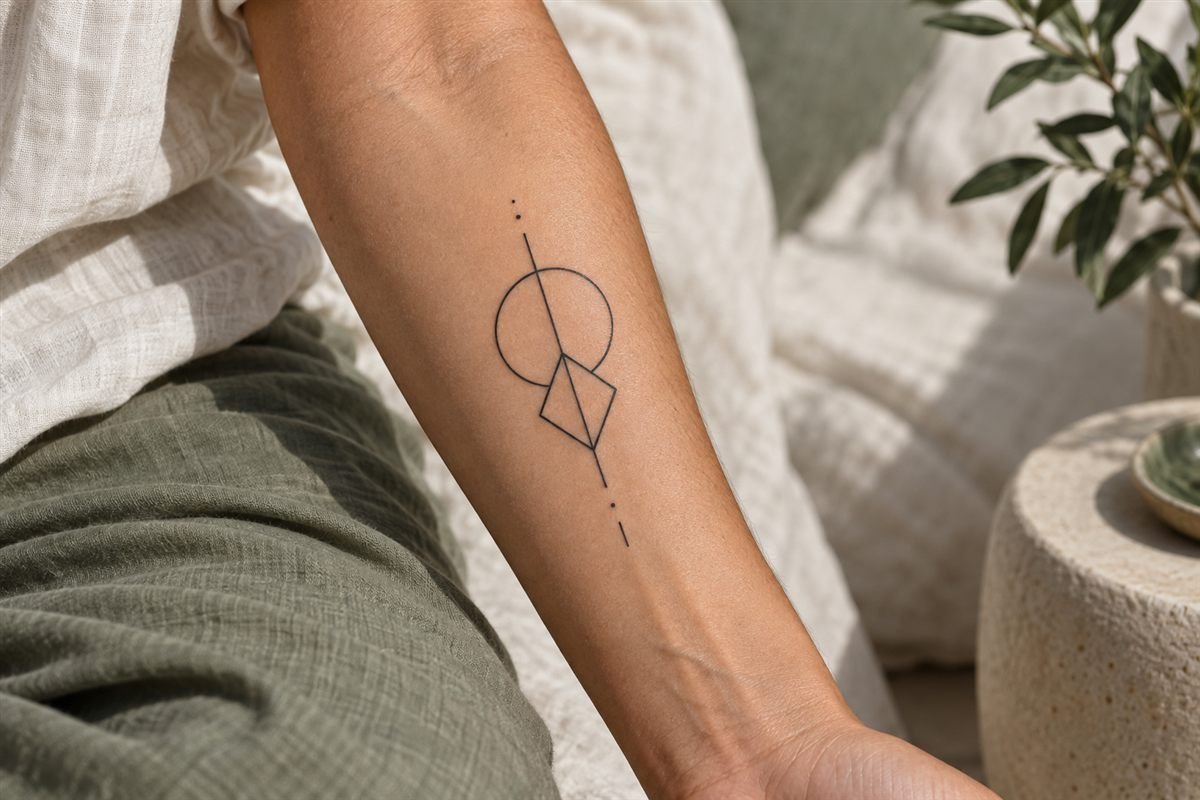
A geometric armband is a pattern on a curved surface, not a flat strip. The point where the pattern meets itself and the way it follows the arm are central design decisions. Work those out before choosing extra decoration.
Choose an open or closed structure
A closed band creates a continuous ring. Its repeat needs to arrive at a deliberate join. An open band leaves a gap, which can become a clear focal point rather than a compromise.
Tell your artist which side of the arm you want to feature. The join or opening does not have to sit where a reference photo places it.
Keep the repeating unit simple
A repeated diamond, line segment, or alternating dark-and-open shape can create rhythm. Start with one unit and ask how many repetitions the actual circumference can support. Forcing an arbitrary number into the space may distort the last section.
If the arm changes width across the band, the pattern may need adaptation. Discuss the whole wrap rather than approving only the front-facing panel.
Check the seam
Look for whether the last shape meets the first cleanly, whether spacing changes abruptly, and whether any line appears to stop by accident. A planned interruption can work well, but it should read as part of the design.
Compare band width and contrast
A narrow band may need fewer details. A wider band can allow more open skin between elements. A heavily filled design will have a different presence from a line-based one even at the same width.
Ask to compare the overall dark-to-open balance from a normal viewing distance. Close-up detail can distract from a band that feels too heavy or too busy on the whole arm.
Respect the origin of a pattern
Original abstract geometry is different from reproducing a pattern tied to a named cultural tradition. Do not assume that a pattern labeled “tribal” in a gallery is anonymous decoration. Research its source and consult an appropriately knowledgeable artist if it has a cultural context.
Approve the whole stencil
Inspect the front, back, and both sides with your arm relaxed. Check how the band relates to existing tattoos and clothing edges. Ask your artist to explain any changes needed for the shape of your arm.
The featured geometric example illustrates the importance of line hierarchy and open space rather than a completed wrap. Browsegeometric tattoo ideasandarm placement guidesbefore deciding how the pattern should travel around you.