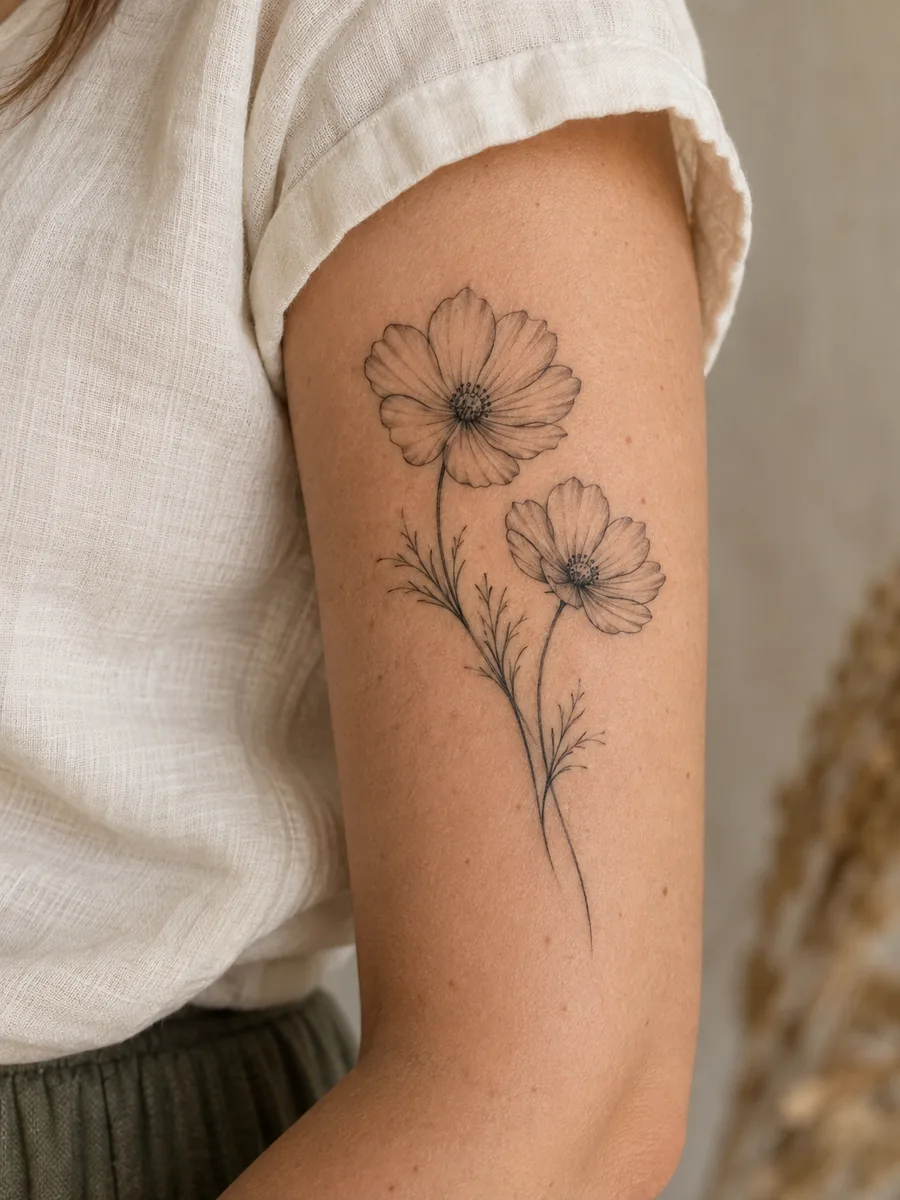
A cosmos-inspired tattoo can feel airy because the flower gives you two very different shapes to work with: an open, round bloom and a long, light stem. The design becomes more interesting when those shapes have room around them.
Rather than fitting the most detail into the smallest space, decide which part should catch the eye first. A broad flower head creates an immediate focal point. A longer stem makes the whole tattoo feel more like a botanical study.
Four ways to build the composition
A single front-facing bloom
Let the petals open around the center with slight differences in angle. Perfectly identical petals can look more like a graphic icon; gentle variation gives a more botanical impression. Keep interior marks selective so the center does not compete with every petal edge.
A bloom seen at an angle
A tilted flower head can suggest motion without adding extra objects. The nearer petals can appear broader while the far side is compressed. This requires more visual explanation than a flat outline, so give your artist enough space to make the angle readable.
Two flowers at different heights
A taller open bloom and a lower, smaller flower create a loose rhythm. Avoid making both stems cross repeatedly. One clear crossing can connect the design; several intersections can turn the lower half into a knot of lines.
A flower with an unopened bud
A compact bud provides contrast with an open bloom. Place it where it balances the flower rather than filling whichever corner happens to be empty. The combination can carry a personal story about change, but it also works simply as a study of different forms.
Petal detail: where to simplify
Choose between a clean outline, a few short interior strokes, and more developed shading. You do not need all three. If the flower is small, ask which details communicate its character and which are decorative extras.
A useful comparison is to look at the design at normal viewing distance, then close up. The outline should still make sense before you notice the finer marks. Ask to see comparable healed work when discussing your expectations for delicate lines.
Placement changes the role of the stem
Upper arm:an open flower can sit above a gently curved stem, creating a self-contained piece. Check how your usual sleeve edge intersects the bloom.
Forearm:the stem can follow the length of the arm, with the flower angled toward the available space. Rotate your arm during the stencil check so you understand which view shows the full bloom.
Lower leg:a longer stem can support a taller composition. Consider the outline of socks and shoes as well as how the design looks standing up.
There is no single best placement for a cosmos tattoo. Your artist should adapt the drawing to the actual area, rather than stretching a finished image until it fits.
Black ink or a restrained color accent?
Black linework makes petal shape and open skin the main design tools. A limited color accent shifts attention toward the bloom. If you want color, show your artist the mood you like and ask for examples on a range of skin tones; a digital illustration is not a reliable preview of your own finished result.
Build an original reference brief
Photograph a flower you are allowed to photograph, or collect references for the flower’s structure rather than copying an existing tattoo. Specify whether you want one bloom, two blooms, or a bud; whether the stem should be straight or curved; and how much detail feels right.
For another botanical direction, compareolive branch compositions. Ourfloral tattoo categoryis the home for flower-specific inspiration, whilefine line ideasfocus on the treatment of the lines.