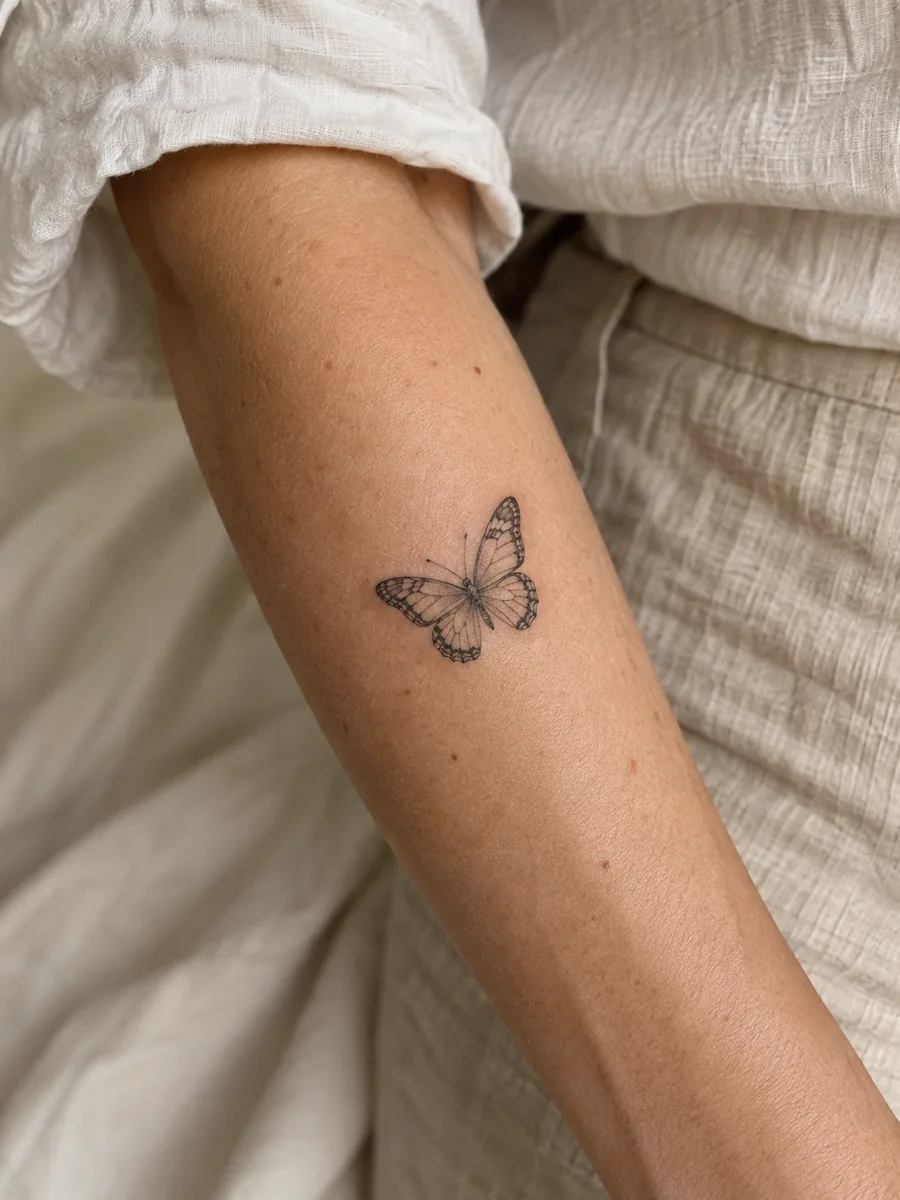
The forearm gives a butterfly tattoo room to do more than sit in the center of a blank space. Wings can open across the arm, angle along its length, or appear in profile. Each choice changes what you see when the arm turns.
Start with the outline. If you like the silhouette before the wing markings are added, you have a useful foundation for a design that does not depend on tiny details.
Open wings, angled wings, or a side view?
Open wings for a clear focal point
A butterfly viewed from above creates a recognizable, roughly balanced shape. On a curved forearm, its outer edges may turn away from the viewer. Ask your artist to position the stencil so the body and major wing shapes read clearly with your arm relaxed, not only with your palm deliberately held flat.
An angled butterfly for movement
Turn the body slightly and allow one wing to appear narrower. This can make the tattoo feel less like a badge and more like a moment in motion. Keep the angle purposeful; a barely tilted symmetrical design can look accidentally crooked.
A side view for a narrow space
A profile butterfly places more emphasis on one wing shape. It can suit a slimmer vertical area, but the artist needs to preserve enough visual cues that it still reads as a butterfly. A clear body and separated antennae help explain the silhouette.
Make the wing pattern work at your chosen scale
Choose a small number of larger interior shapes instead of filling every area with fine marks. A bold edge with open areas can look very different from an evenly delicate outline. Compare both before choosing a style.
If a particular butterfly species matters to you, bring accurate natural-history references and tell your artist which identifying features matter. If the design is imagined, describe it as a stylized butterfly rather than attaching a species name to an approximate pattern.
One butterfly or two?
A pair can suggest movement along the forearm. Change the size or angle so the second butterfly contributes something rather than duplicating the first. Leave a visible gap between them. Avoid adding a third simply because a reference gallery did; the available space and your preference should set the composition.
Check orientation in everyday positions
Look at the stencil with your hand by your side, palm turned up, and elbow bent. Decide which view matters most to you. If you expect to add more tattoos, consider whether the butterfly should be a central piece or an accent that leaves space nearby.
A watch, sleeve cuff, or existing tattoo can change the balance. Bring photographs of the whole arm if the consultation happens remotely, and include a ruler or a clear size reference.
Meaning is optional and personal
You may connect a butterfly with change, someone you love, or a place you remember. Those are your associations. There is no requirement to choose a symbolic story, and different people and cultures may read the same motif differently.
Exploremore butterfly ideasandarm placement guides. If you want a botanical companion, compare the open shape of acosmos flowerbefore asking your artist to combine both motifs.