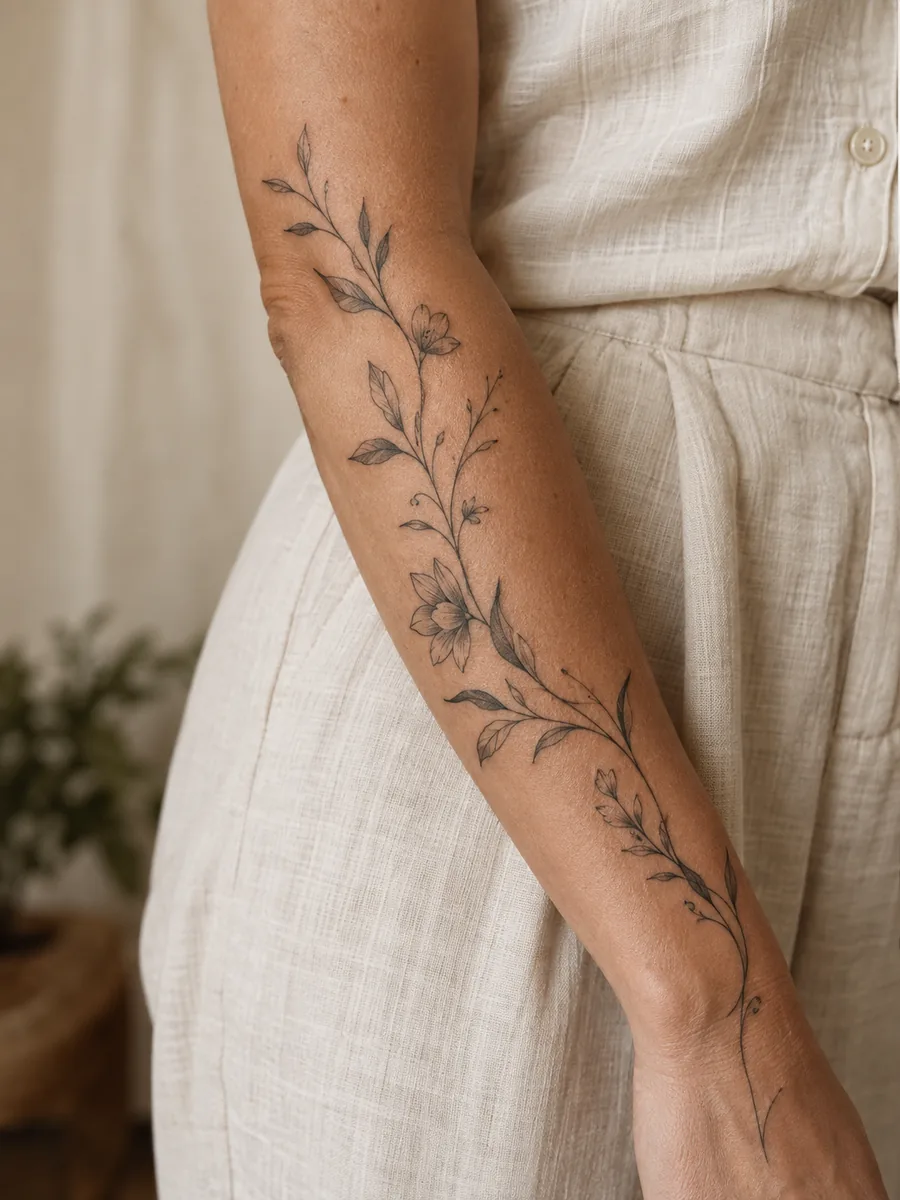
A botanical forearm tattoo can be a small accent, a long vine, or the beginning of a larger collection. The useful question is not which version is most feminine, but how you want the design to move along your arm and fit into your everyday life. These ideas are for anyone drawn to the style.
Find the main direction first
Before choosing flowers or leaves, imagine one line through the composition. A mostly straight line feels upright and organized. A shallow S curve introduces movement. A wrap travels around the arm and will never be fully visible from one viewpoint.
Ask your artist to sketch that main direction before adding details. This makes it easier to see whether you like the placement, rather than being distracted by a beautifully drawn flower in the wrong spot.
Three different approaches
A spare vine
Use a stem with a few spaced leaves and let the skin between them remain part of the design. This can feel light without requiring every line to be extremely thin. A slightly clearer central stem helps the eye follow the vine.
A focal bloom with supporting greenery
Choose one flower as the main event. Smaller leaves can lead toward it without competing for attention. If the flower faces outward while the stem follows the inner arm, check how the transition looks as you rotate your wrist.
A loose botanical panel
Several stems can form a taller composition with open edges. Avoid treating it as a rectangular illustration pasted onto the arm. Uneven tips and carefully placed gaps can help the design end naturally.
Scale changes the experience
A small sprig asks the viewer to look closer. A longer piece becomes part of the overall outline of your arm. Neither is automatically more elegant. Compare actual-size mockups with your whole arm visible, not only close-up crops.
If your reference includes many small leaf veins or overlapping stems, ask which details should be simplified. The goal is a readable design, not a reduced copy of a large drawing.
Think about clothing and future tattoos
Try the stencil with the sleeves and jewelry you wear most often. A cuff can cut across a flower, while a watch can occupy the space where the lowest leaf was supposed to end. These are composition questions worth resolving before the appointment begins.
If you may add more tattoos, tell your artist. A self-contained vine can leave flexible space around it; a design that wraps across several areas may set the direction for later work. You do not need a complete sleeve plan, but you should avoid accidentally using the space you wanted to save.
Choose references for different reasons
Bring one image for botanical shape, one for line weight, and one showing a placement you like. Explain the specific feature in each. Ask for an original composition rather than a direct copy of someone else’s tattoo.
For a lighter branch, exploreolive branch design variations. For a round focal flower, comparecosmos tattoo ideas. Thearm and wrist categoryfocuses on the placement decisions that connect these different styles.