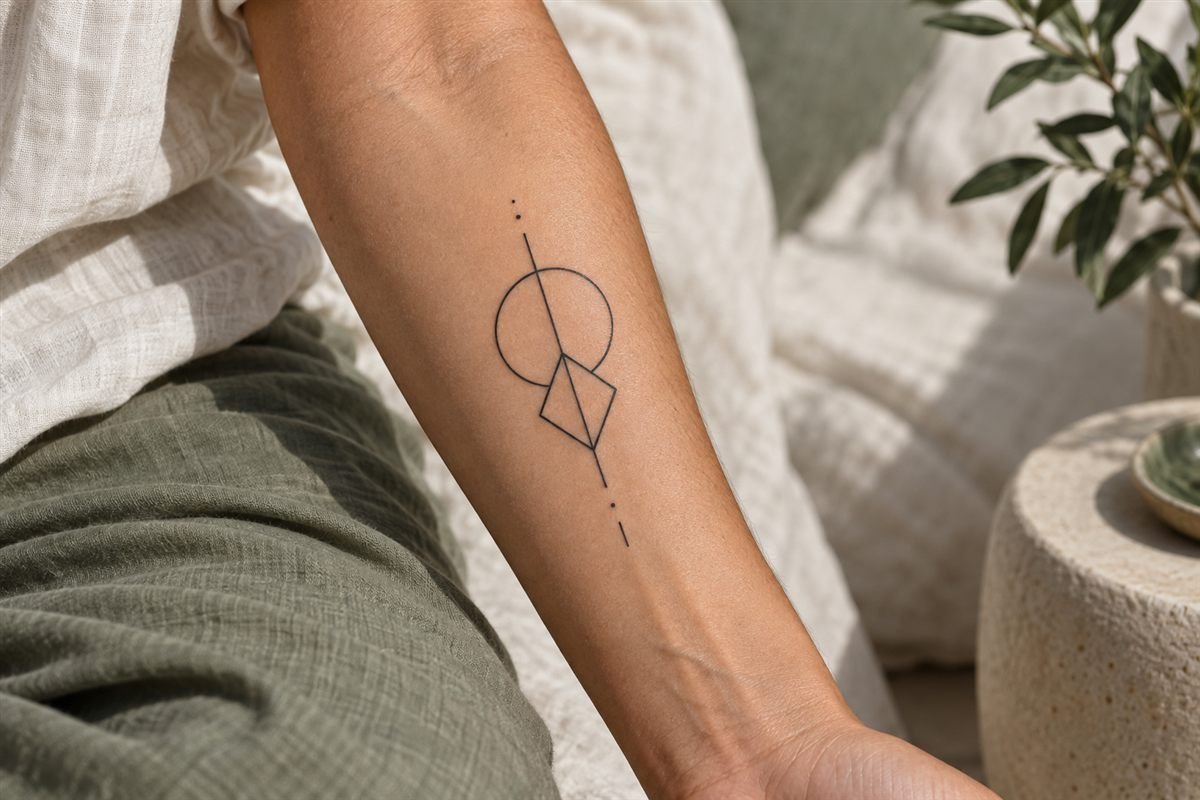
A geometric tattoo can look simple on paper and become surprisingly complex on a curved arm. Circles turn away from the viewer, long axes shift with rotation, and repeated lines can draw attention to small differences. Start by choosing the main view you want the design to have.
Build around one dominant shape
A circle, diamond, or long axis can organize the composition. Choose one as the anchor, then decide what the other elements contribute. If every shape is equally prominent, the design can feel like several unrelated symbols stacked together.
Circle and offset diamond
A round shape beside an angular one creates contrast without requiring shading. Offset the diamond enough that the overlap looks deliberate. Decide whether intersecting lines should continue through both shapes or stop at their edges; the two choices produce different effects.
Nested shapes
One outline inside another can create a quiet, contained design. The space between the outlines is as important as the lines themselves. Ask your artist to show the composition at actual size so that the gap does not become an afterthought.
A broken vertical axis
Short separated line segments can connect a group of shapes without creating a heavy central stripe. Use gaps to establish rhythm. A small number of intentional breaks usually reads more clearly than a long sequence of tiny decorative marks.
Use line weight to create order
The main shape can be slightly stronger than the supporting marks. Alternatively, keep all lines similar and create hierarchy through size. Ask your artist which approach fits the space and their technique. A digital drawing with perfectly uniform lines is a concept, not a guarantee of a tattoo result.
Alignment on a moving forearm
Check the stencil with your arm at rest and in the position where you expect to see the tattoo most often. A line that looks straight from one angle may appear to curve from another because the surface curves. Talk through which view takes priority.
If a circular shape is central to the design, check whether you are comfortable with its appearance as your arm rotates. Moving or resizing the composition may be more useful than adding extra lines to compensate.
Keep enough open skin
Open areas help separate the forms. If the design seems unfinished, first ask whether it needs a stronger focal point rather than more dots and small shapes. Blank space is a deliberate part of a geometric composition.
Original geometry and cultural references
This guide concerns original abstract arrangements. The site’s existing Geometric & Tribal category also includes a term that covers many distinct traditions; those traditions should not be treated as interchangeable decorative patterns. If your reference comes from a named community, research its context and consult an artist with relevant knowledge before adapting it.
Bring a short brief: the anchor shape, desired length, preferred line weight, and the viewing angle that matters to you. Browsegeometric design ideasandforearm placement guidesto refine the composition.