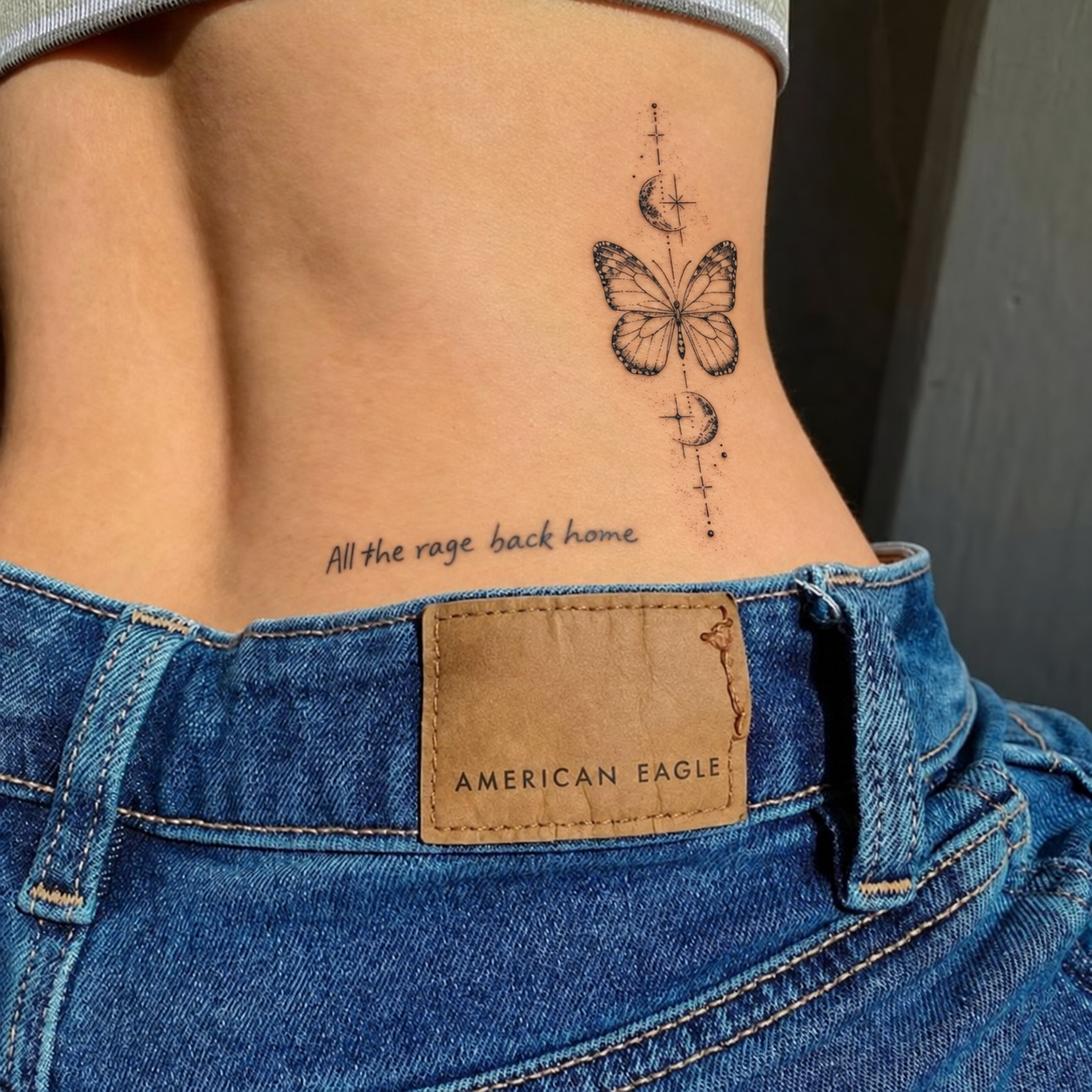
A butterfly and moon lower back tattoo can be built around a simple central idea: open wings, a crescent above, and a second crescent below. Small stars and fine marks extend that arrangement into a vertical ornament. Unlike a broad design stretching across the waist, this concept concentrates the detail close to the center of the lower back.
Image note: the featured image is an AI-generated tattoo placement mockup, not a photograph of a completed tattoo. The lettering visible in the reference is separate from the new butterfly design.
A centered alternative to a wide lower back tattoo
The butterfly provides width, while the moons create height. That combination gives the design structure without requiring a large horizontal pattern. The wings can remain fairly symmetrical even when the shading or small celestial marks differ slightly from side to side.
If you like a more minimal look, remove some stars and keep only the butterfly with two crescent shapes. If you prefer a wider composition, discuss small outward accents with your artist rather than stretching the butterfly until its proportions change.
Choosing the position above your waistband
The waistband in a styled image is only one reference point. Different jeans, skirts, and trousers sit at different heights, so decide how much of the tattoo you want visible in your usual clothes. A centered piece can look intentionally framed by a waistband, but its lower details may be hidden by another outfit.
Ask to compare the stencil while standing naturally and sitting. You can also request a photograph taken from directly behind to judge the relationship between the wings, the center of the back, and nearby tattoos. Placement should be adapted to you rather than copied from the proportions of a digital mockup.
Moons, balance, and personal meaning
Two crescent moons do not automatically make a complete moon-phase sequence. In this idea, they work primarily as visual accents around the butterfly. If you want an actual sequence of lunar phases, tell your artist so that the arrangement can be designed deliberately.
You may associate the butterfly with a new chapter and the moon with recurring cycles. Another person may choose the same shapes because they enjoy celestial art. Both approaches are valid; there is no single meaning that every butterfly and moon tattoo must have.
Keeping fine details readable
The reference includes delicate wing lines and small decorative marks. At a reduced size, those details may need to be simplified. Start by deciding how much space you want the entire piece to occupy, then let the artist adapt the internal pattern to that scale.
Compare a plain outline version with one that includes light shading. The former emphasizes shape, while the latter adds texture and contrast. Looking at your artist’s portfolio and healed examples can help you choose an approach that matches their work.
Planning around existing lettering
Existing script can remain a separate element or become part of a larger composition, but that decision should be made before the final drawing. In this mockup, the lettering comes from the reference photo; it is not a phrase you need to copy. Leave enough visual space so that neither the words nor the butterfly appears accidentally crowded.
- Show your artist the existing tattoo at its current size and placement.
- Decide whether the new design should align with the script or stand apart.
- Confirm the upper and lower endpoints of the celestial accents.
- Review the stencil as a complete composition, not only as individual symbols.
Save the pin as a visual brief and request an original lower back design built around your preferences. For more possibilities, explore ourbutterfly tattoo ideasandminimalist tattoo designs.